

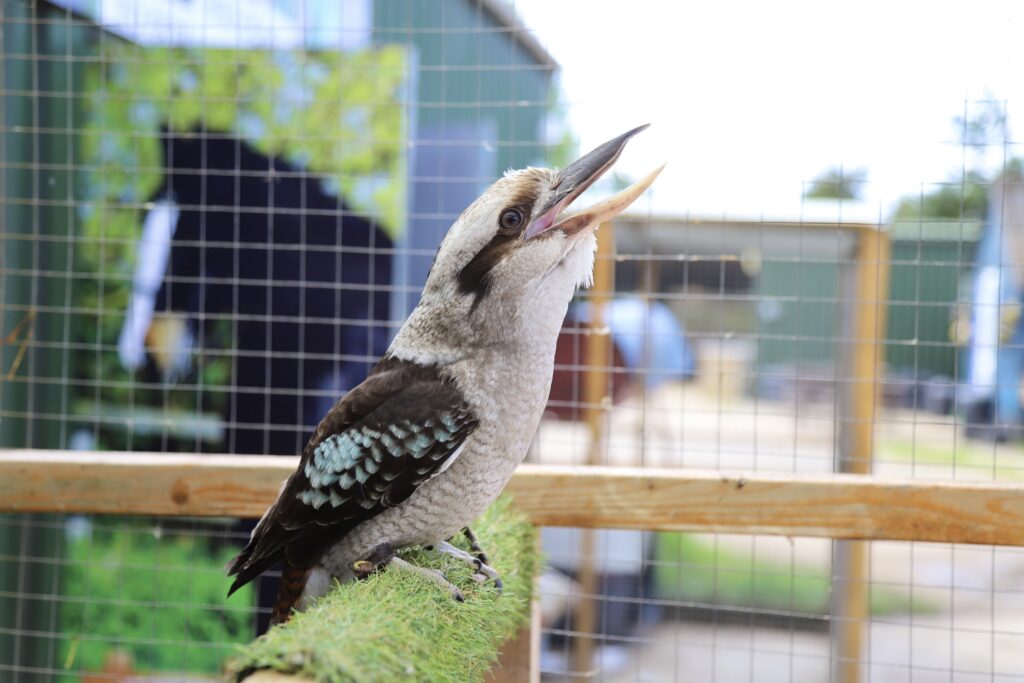
Kookaburras at Our Animal Sanctuary
The kookaburra is a bird species native to Australia and belongs to the kingfisher family. There are four recognised species of kookaburra, with the Laughing Kookaburra being the most well known and widely recognised.
The Laughing Kookaburra is famous around the world for its unmistakable call, which sounds remarkably like human laughter. This distinctive sound can carry for several kilometres and is often heard at dawn and dusk.
If you’d like to learn more about our sanctuary and the animals we care for, you can visit our About Us page.
The Laughing Kookaburra is a medium-sized bird, measuring up to 45 centimetres in length and weighing around 500 grams. It has a distinctive appearance, with a large head, brown and white plumage, and a long, powerful beak designed for catching prey.
Although kookaburras belong to the kingfisher family, they are not fish-eating birds. Instead, they spend most of their time hunting on land.
Kookaburras are found throughout much of Australia, from tropical northern regions to more temperate southern areas. They live in a wide range of habitats, including forests, woodlands, open countryside, and even urban environments.
Because they adapt well to different surroundings, kookaburras are often seen near parks, gardens, and farmland.
Kookaburras are carnivorous birds. Their diet includes insects, worms, lizards, snakes, small mammals, and occasionally other birds. They hunt by watching from a perch and then swooping down to capture their prey.
Once caught, prey is often beaten against a branch or the ground before being swallowed whole.
Kookaburras are monogamous birds and usually mate for life. They nest in tree hollows, and both parents play an active role in incubating the eggs and raising the chicks.
Family groups may remain together for several years, with older offspring sometimes helping to care for younger birds.
The Laughing Kookaburra holds a special place in Australian culture. It is often featured in art, literature, and folklore and is famously referenced in the nursery rhyme “Kookaburra Sits in the Old Gum Tree.”
We are very fortunate to care for Kookie, our resident kookaburra. Visitors are often captivated by his unmistakable call, which never fails to raise a smile.
Take a look at the video above to hear Kookie’s incredible laugh for yourself.
If you would like to visit the sanctuary and meet some of our animals in person, you can find out more here: Visit Northcote Horses & Animals
As a registered charity, the care we provide is made possible through public support. By supporting our sanctuary, you help us continue to give specialist care to animals like Kookie and many others: Support Our Sanctuary
The kookaburra’s “laugh” is a territorial call. It helps family groups establish boundaries and communicate with neighbouring birds.
Yes, kookaburras belong to the kingfisher family. However, unlike most kingfishers, they mainly hunt land-based prey rather than fish.
Kookaburras eat insects, reptiles such as lizards and snakes, small mammals, and other small animals. They are skilled and opportunistic hunters.
Many kookaburras live in family groups. Older offspring may stay with their parents for several years and help raise younger chicks.
In the wild, kookaburras can live for around 15 to 20 years. With good care, they may live longer in managed environments.